January 2023

Remembering Duke Wright: A Tribute to a Legend

On December 21, 2022, the radio industry mourned the loss of one of its legends as Duke Wright, owner of Midwest Communications, passed away at the age of 83.


Duke Wright in the office of Midwest Communications

In a radio career that spanned six decades, Duke touched countless lives through his mentorship, leadership, and passion for radio. He leaves behind a legacy shaped not only by his success as a pioneer in the industry, but by the generous love he shared with family, friends, and colleagues.

In this article, we pay tribute to the life and career of Duke Wright. Join us as we celebrate the impact he made and remember the legacy he left behind.

Surrounded by Music

Duey “Duke” Edward Wright Jr. was born in 1939 into a home that was filled with the love of music.

Duke’s parents, Duey Sr. and Julia Wright, owned Wright’s Music Store in Wausau, Wisconsin. Duey Sr. had carried on the legacy from his own father, Hervey, who built the first Wright’s Music Store in Marshfield, WI. Duey Sr. operated that store until 1928 before moving to Wausau and opening the store there. Wright’s Music Store offered everything from radios, jukeboxes and TVs, to musical instruments and lessons.
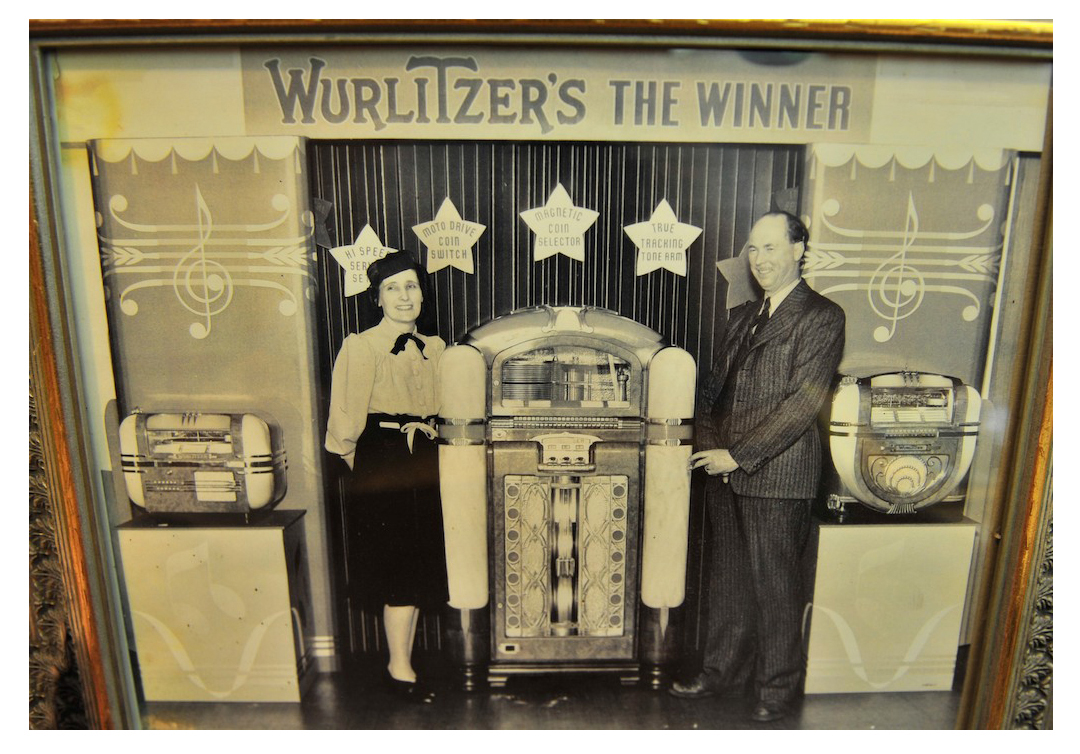
Julia and Duey Wright Sr.
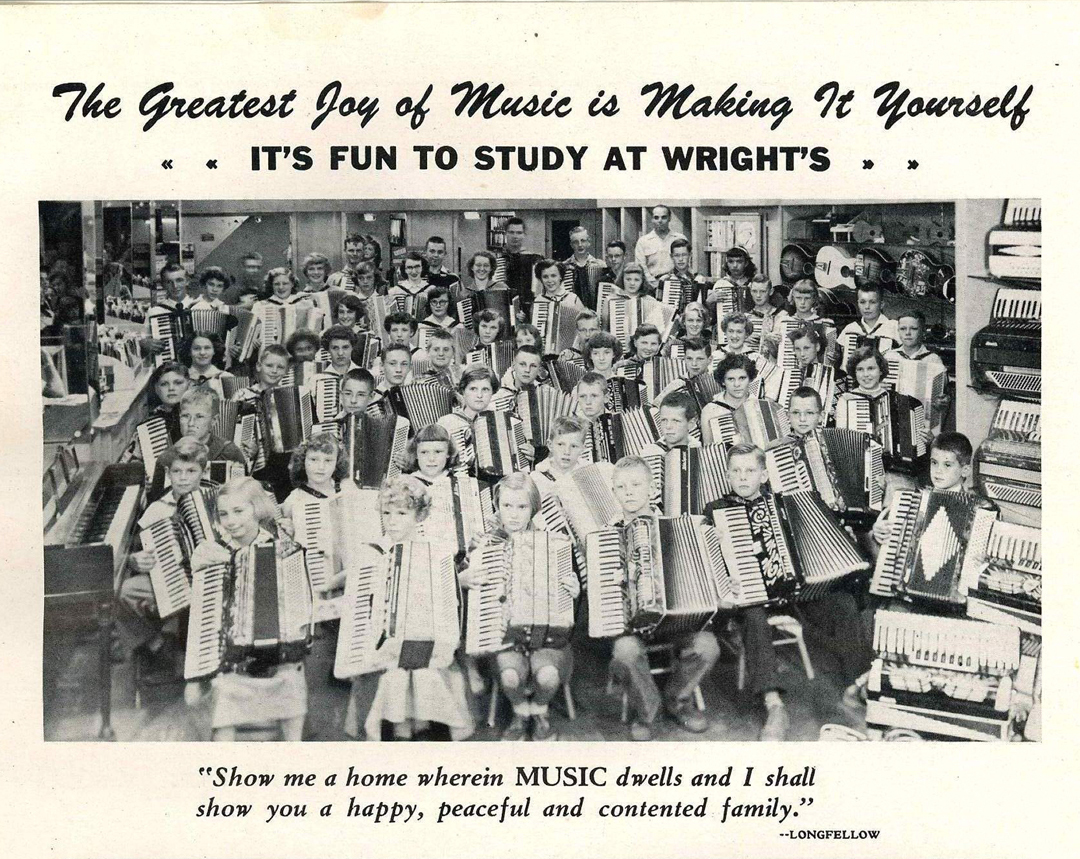
Students at the Wright’s Music Store. With a Midwestern love of polka, accordion the instrument of choice.
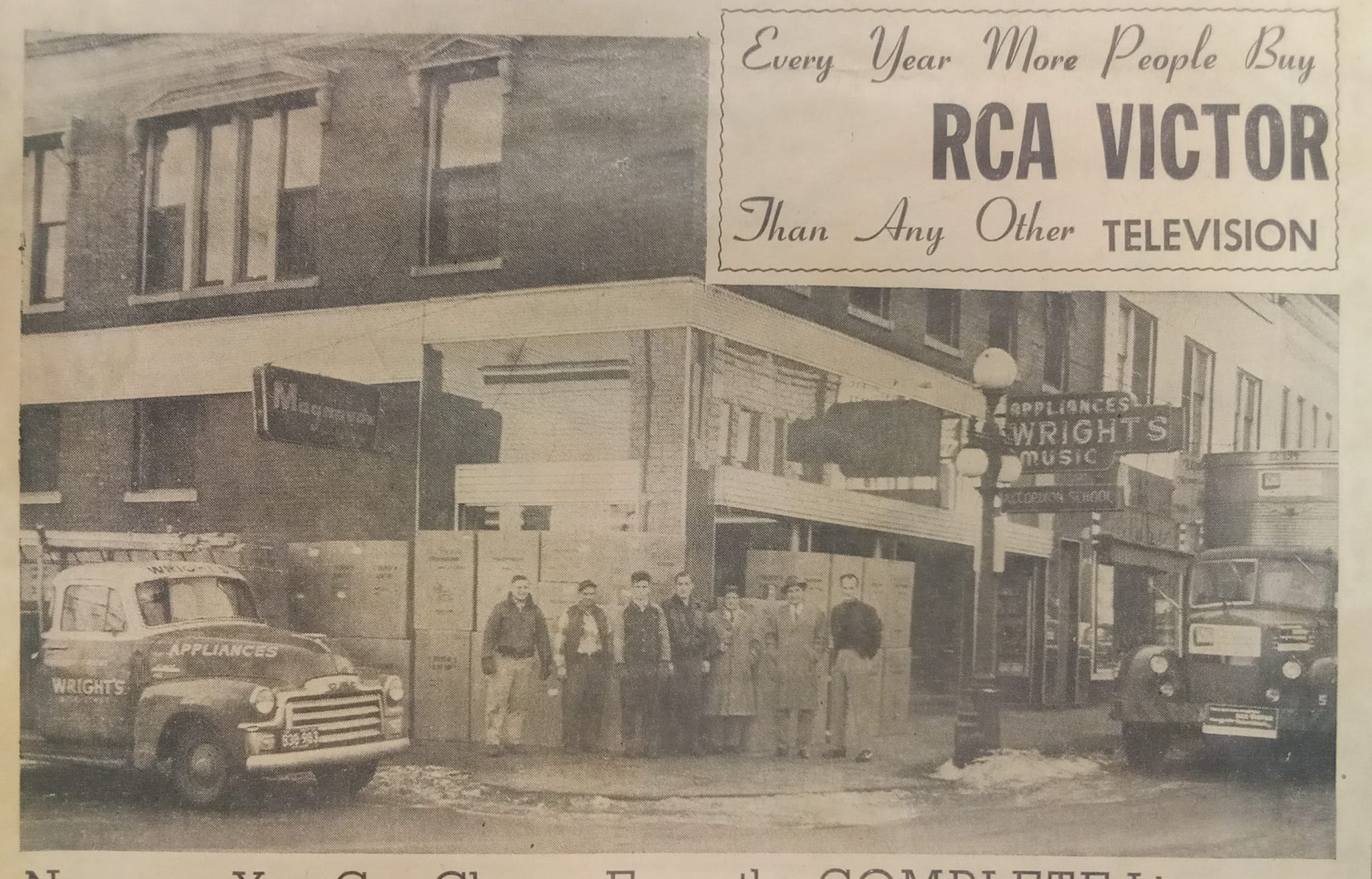
Wrights Music Store pictured in an early advertisement. By this time, they'd already been in business for 49 years!
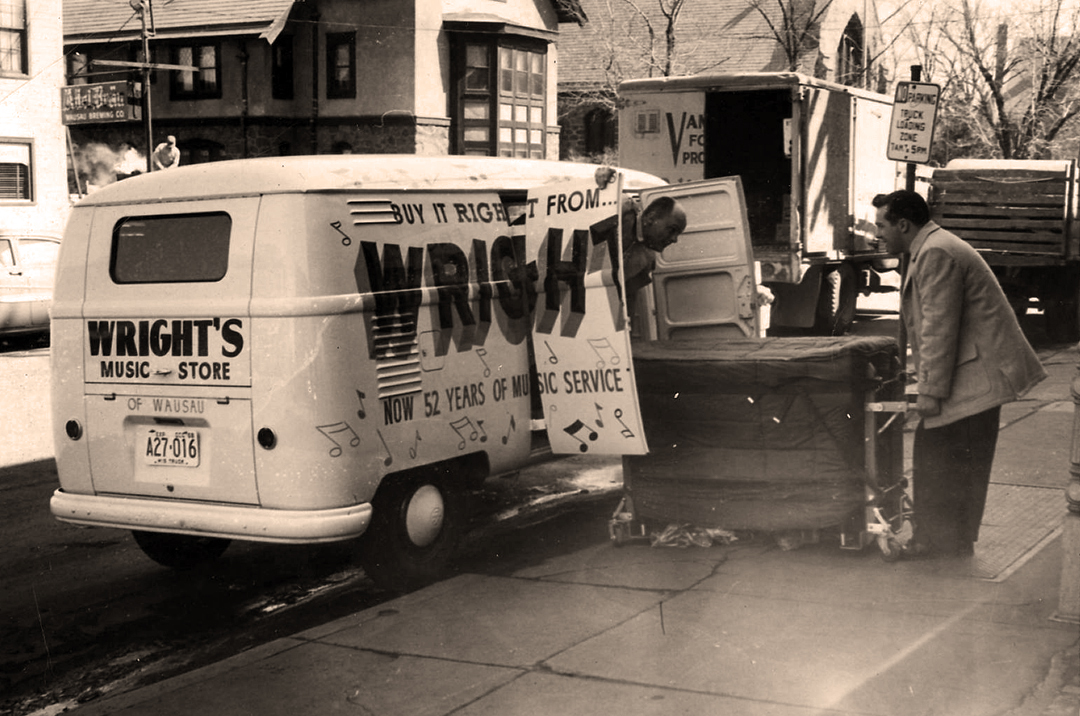
Wrights Music Store van making deliveries, circa 1970s

When Wausau radio station WSAU first launched in 1937, the Wright’s Music Store bought the very first advertising spot it aired. Sixty years later, when Duke acquired WSAU for Midwest Communications, he found a copy of that first day’s log preserved - including the spot for his family’s store.

The Wrights were, in every sense of the word, surrounded by music. In a tribute to their musical background, the family’s 1958 home was designed by Frank Lloyd Wright (no relation) with a unique L shape to resemble a musical note when viewed from above. To achieve the design, Julia Wright herself made tweaks to Frank Lloyd Wright’s blueprint. (The home is now used as a corporate office for Midwest Communications and is listed on the Wisconsin Register of Historic Sites.)
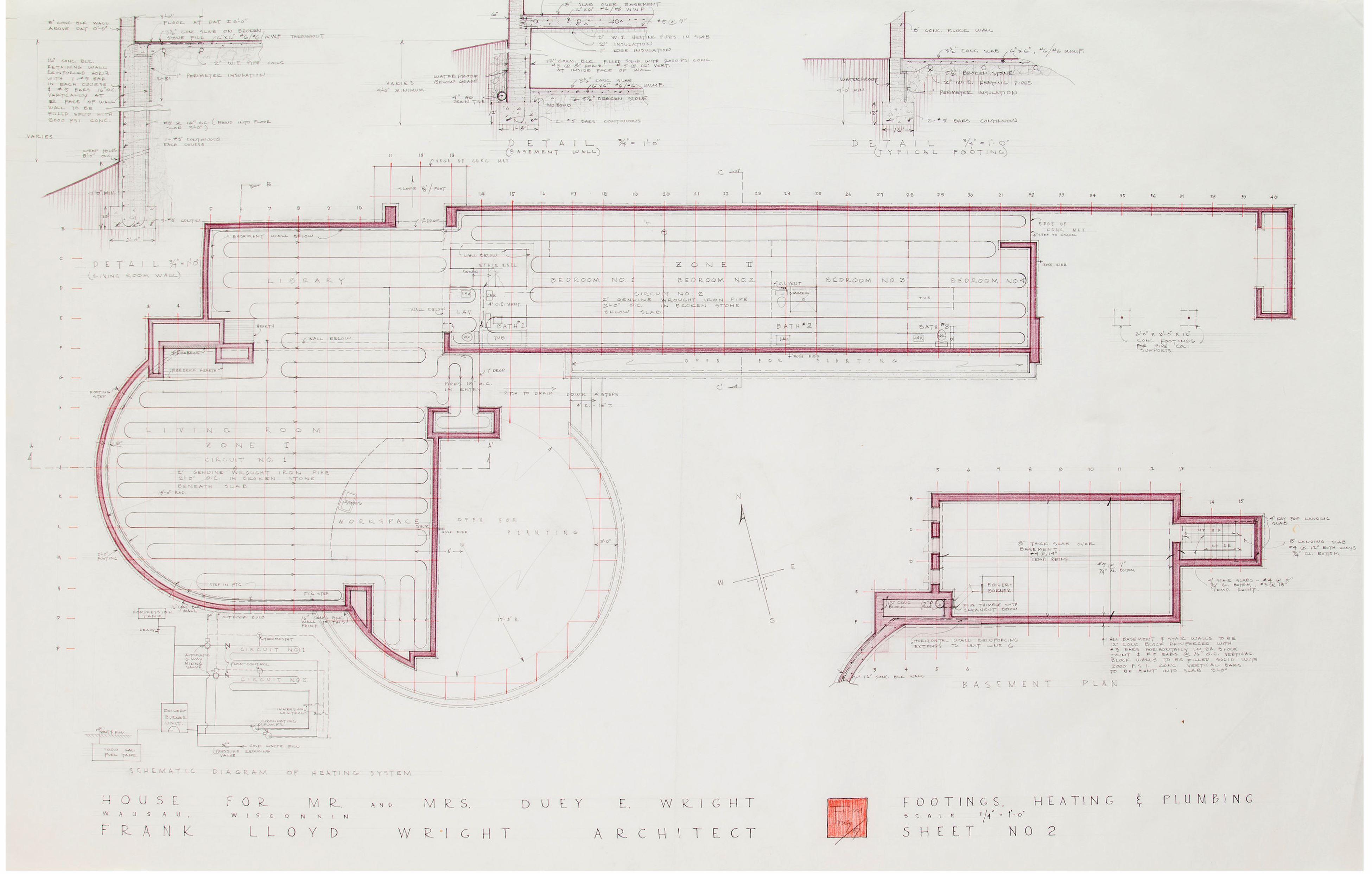
Frank Lloyd Wright's blueprints for the home
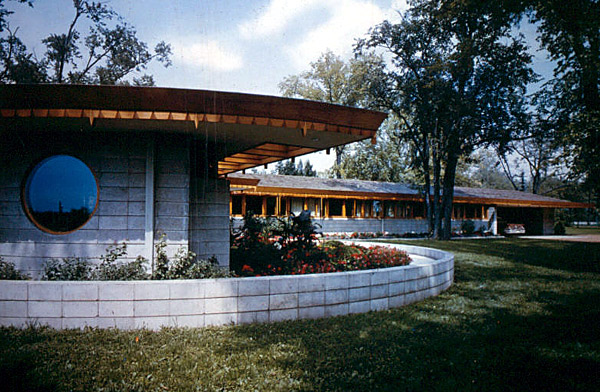
A view highlighting the home's unique shape
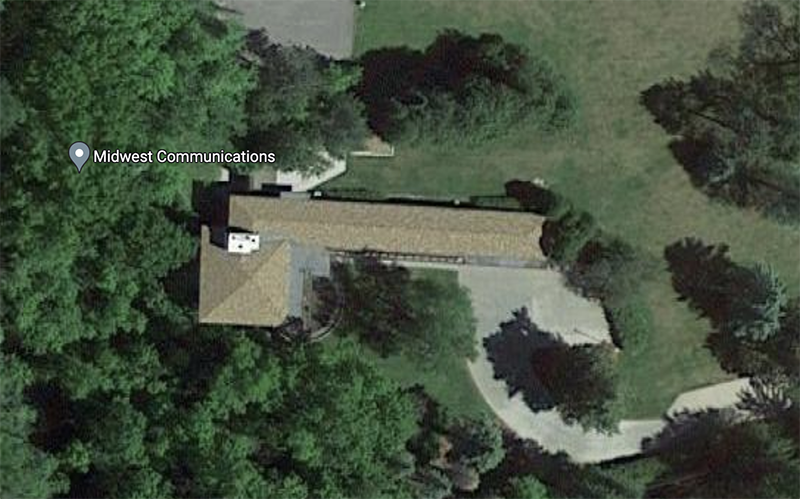
The resemblance to a musical note when viewed from above

Duke The Musician

Duke’s mother taught piano, and young Duke began learning at the age of four. Later, he went on to play bass guitar, upright bass, and clarinet. But as a young teen, Duke’s musical path was forever changed when he tagged along with his parents to a performance given by polka great Frankie Yankovic. Blown away by what he heard, Duke dreamed of becoming a professional musician and signed up for accordion lessons the very next day.

Soon after, the talented teen had mastered the instrument and started his own group, The Duke Wright Orchestra and the Nutones. By age 15, he was hosting a weekly music show on WSAU-TV in Wausau, WI. In fact, the next time Duke saw Frankie Yankovic, they played on stage together. They would continue to play together for many years.
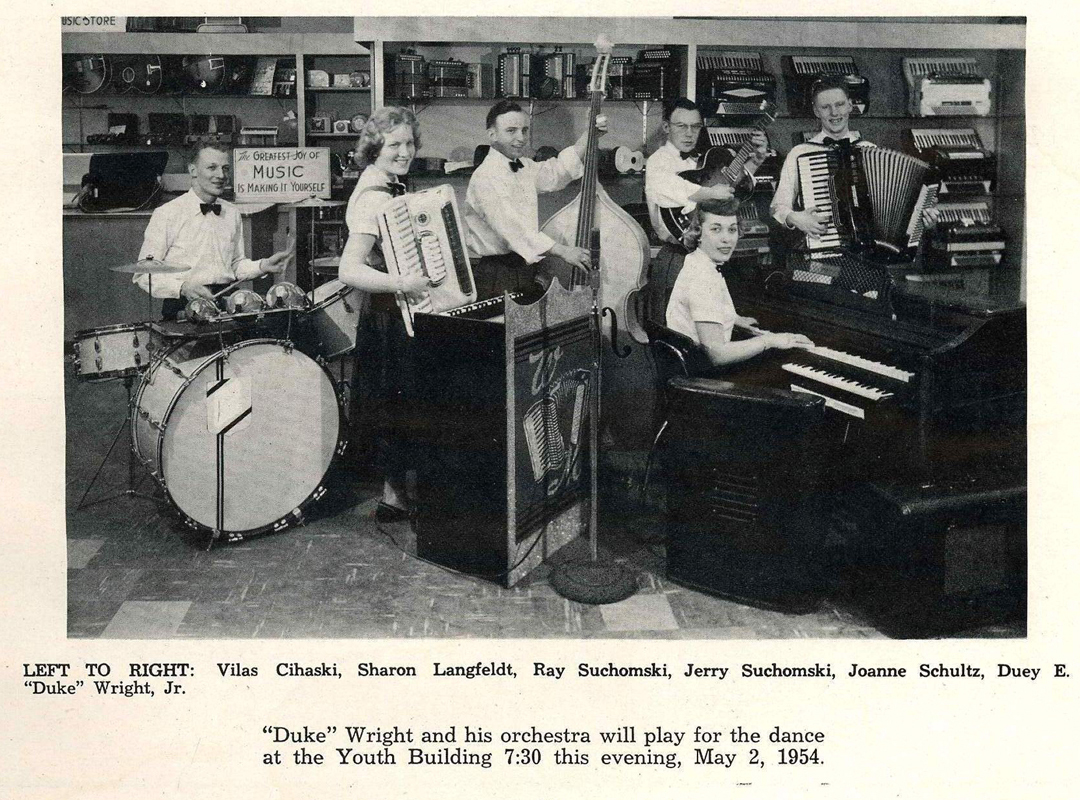
Newspaper clipping from 1954, advertising a Youth Dance featuring music by Duke Wright and his Orchestra. Duke, on the far right, was 15 years old.
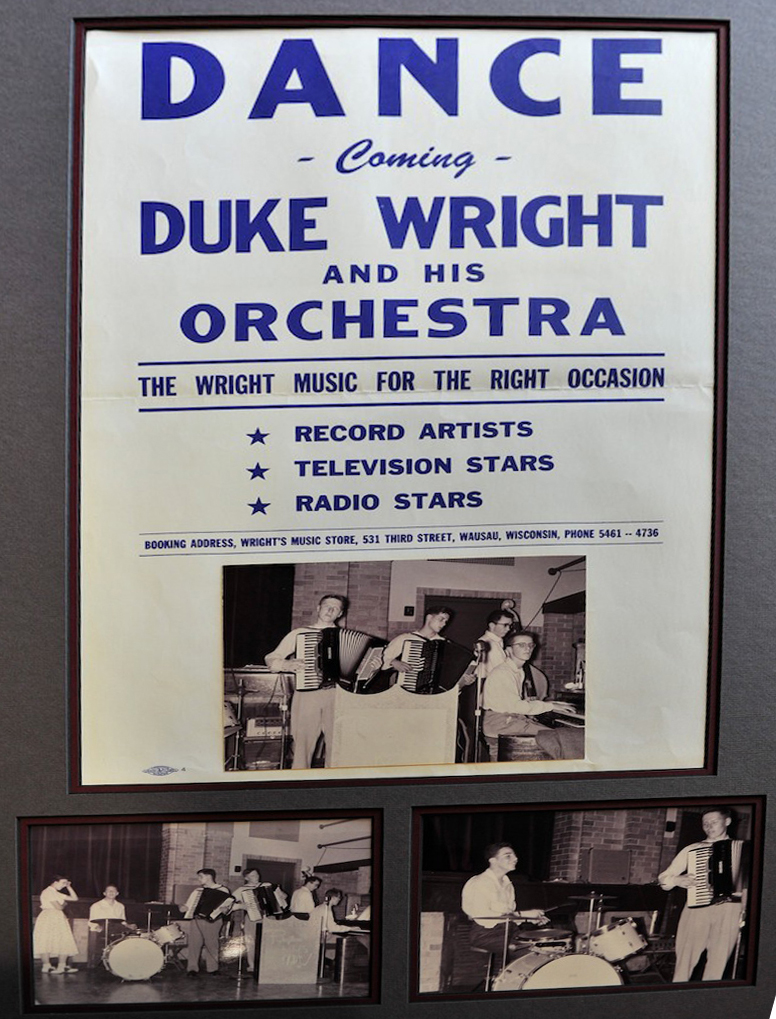
More images of Duke and his orchestra, playing "the Wright Music".

Duke recorded a number of different albums under his Northland Records label and the Polkaland label, pictured below. You can listen to a recording of Duke playing Ferryboat Serenade archived here. This album was likely produced in 1955 or 1956, when Duke was around sixteen years old.

Duke pictured with his accordion

For his years of contributions to the art of polka, Duke received the Distinguished Service award from the Wisconsin Polka Hall of Fame in 2010.
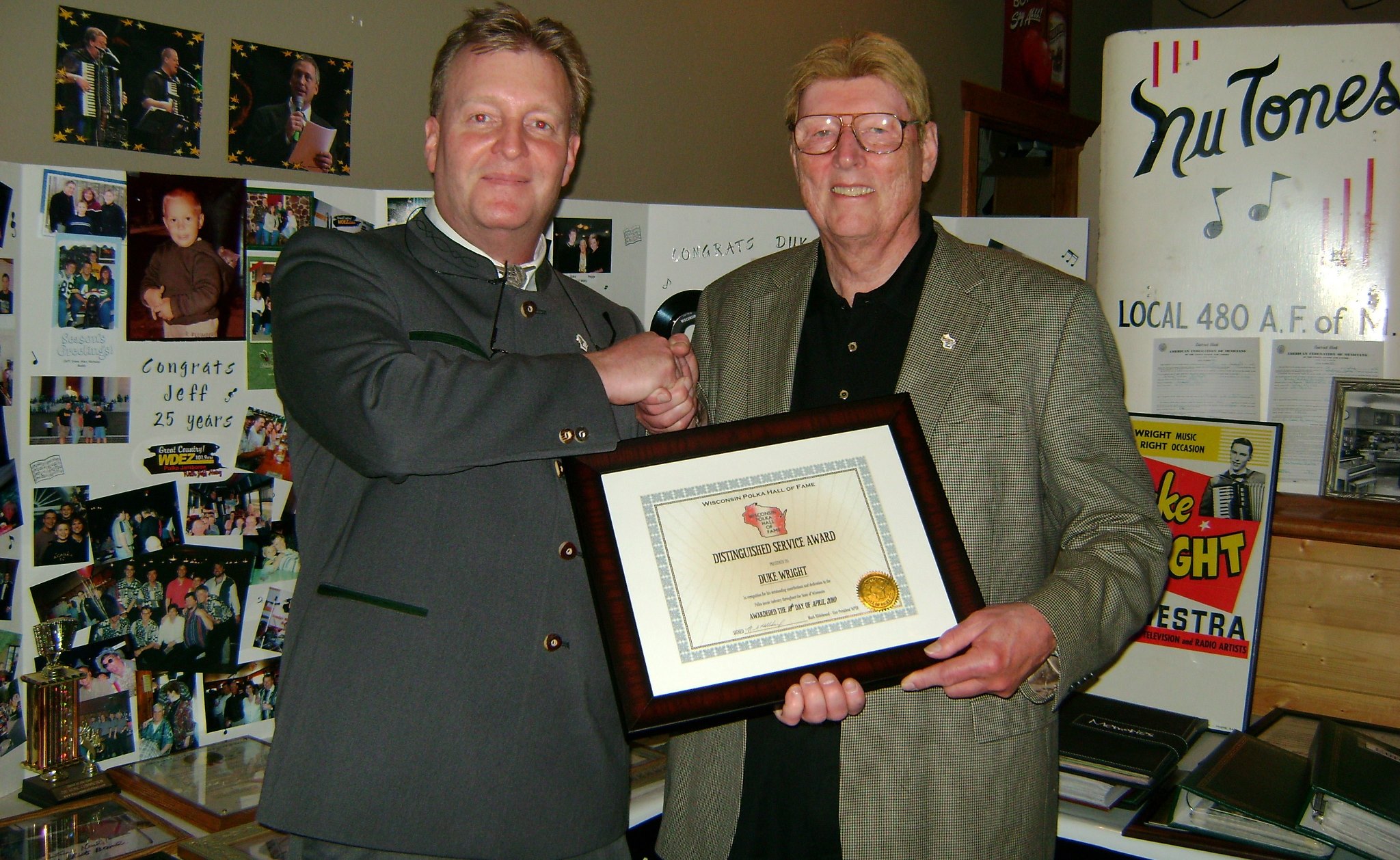
Duke pictured with his Polka Hall of Fame award, surrounded by memorabilia.

Following the ceremony, Duke played a few songs with The Music Connection, including “The Beer Polka” which you can watch below.

Duke’s Northland Records: Pioneer of Music in Wisconsin

In his early days as a performer, Duke also founded the Northland Records label, which helped pioneer rock and roll music in Wisconsin. Writing about the birth of rock and roll in Wisconsin, MusicMaster’s Joe Knapp shared the story of a local polka band called The White Caps who transitioned to the rock sound after hearing the release of Rock Around The Clock by Bill Haley And The Comets.

In January 1957, the band gathered at Duke Wright’s Northland Sound Studios. They recorded two songs during that session: Rock ‘N Roll Saddles and Why’d You Leave Me? Duke himself filled in on bass guitar. The 45 RPM single released from that session came to be known as the very first rock and roll record ever made in Wisconsin, for which Duke was later honored by the Wisconsin Rock & Roll Hall of Fame. You can listen to it below.
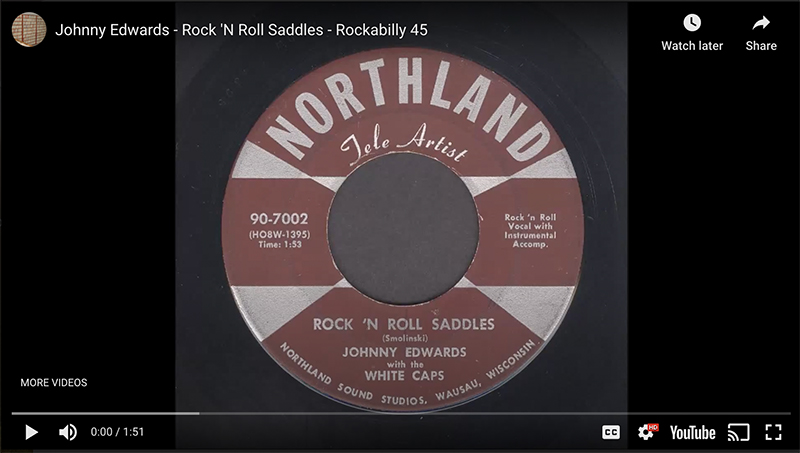
A True Passion for Radio

Despite his musical proficiency, Duke had an even greater passion for radio. As a very young boy, he would sit and listen to the family’s radio, fascinated by the sounds it produced.

Sensing their son’s interest in communications, Duke’s parents purchased a small 250-watt AM station in 1958 for $54,000. They renamed it WRIG. While still in high school, Duke began working in the station, which occupied the space above the Wright’s Music Store in downtown Wausau.

After graduating, Duke moved to Madison, Wisconsin to study business at the University of Wisconsin. There, he joined the National Guard and served in the Army Reserves for eight years, rising to the rank of Army Captain. From his years of service, Duke said he credited much of what he learned about working with people and his general business savviness to his commanding officer, Dale Earlerson.

After earning his business degree, Duke returned home and took on the role of General Manager at WRIG. In 1964, foretelling the dominance of FM radio, Duke built WRIG-FM and broadcast it as a simulcast of WRIG-AM. It would be the first FM station in Central Wisconsin. On the very first ratings book ever released in the county, the station was ranked number one.


Duke's business card from WRIG-FM

In 1971, Duke launched Midwest Communications with his first expansion outside of Wausau, adding WROE in Appleton.

A year later, while promoting WRIG at the Central Wisconsin State Fair, Duke crossed paths with the love of his life, Pegge. The encounter would lead to a loving marriage and partnership that spanned over half a century.


Duke and Pegge on their wedding day
Midwest Communications Expands

In 1976, Duke competed with Green Bay Packers quarterback Bart Starr to purchase Green Bay’s WBAY-AM/FM. Following the successful acquisition of the stations for $1 million, Duke renamed them to WGEE and WIXX and moved to Green Bay to continue growing his business and his family.

There, over the next 50 years, Duke expanded Midwest Communications into one of the largest independently owned, family operated broadcasting companies in the United States.

Of Duke’s quest to add stations, Midwest Communications VP/Programming Jeff McCarthy said, “For him, it was never about the numbers. It was about quality.” Duke’s vision was always about super-serving the local community. “He was always about the listeners experience when they turn on one of his stations.”

And with Duke’s engineering background, he knew the importance of putting quality sound out through the speakers to avoid listener fatigue. He strove to have the best processing, signal, and equipment so when people tuned in, they just felt better about what they were hearing.

Shane Finch, National Sales Director for Broadcasters’ General Store, has had the pleasure of knowing and working with Duke since 1987. He shared, “While many consider Duke to be the consummate radio owner, he was truly a businessman extraordinaire. I fondly remember his visits to the stations and watching as he excitedly checked out the new equipment that had arrived. He knew the purpose of every component and how it would benefit the stations, advertisers, and ultimately the listeners. Not a day goes by when I don’t resort back to the business experience I gained working for Midwest Communications. Long-live Duke Wright through the amazing listener experiences he helped create.”
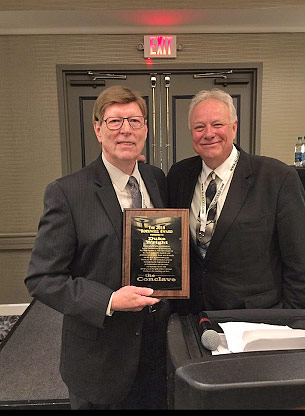
Duke with Jeff McCarthy at Conclave in 2016, where Duke was honored with the Rockwell Award
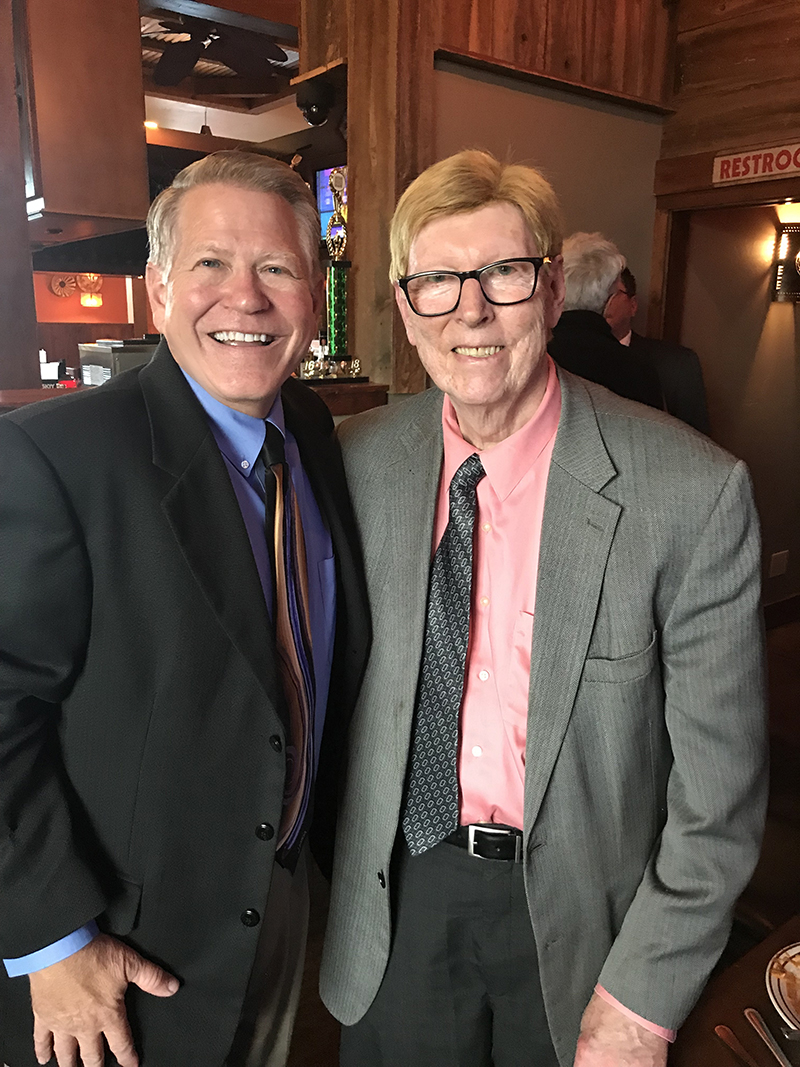
Shane Finch with Duke Wright

For Duke, great radio was also about people. On the air, personalities were key. At WIXX, for example, Duke made sure someone was always in the building, 24/7, so when anything happened in the community, listeners knew where to tune in – and they did.

When acquiring new stations, Duke didn’t just make cuts or start from scratch. He studied the people there and found out what had made them successful. Then, he would reinvest in whatever they needed to achieve a higher level.

“He allowed you to take chances and create,” Jeff recalled. “Our philosophy really has been this - we hire or acquire the best, we give them absolute clear direction and the tools to win, and then we get out of their way.”

Midwest Communications currently owns 81 radio stations and 75 brands in communities throughout Illinois, Indiana, Kentucky, Michigan, Minnesota, North Dakota, South Dakota, Tennessee, and Wisconsin.

But as Jeff pointed out, “Even though we’ve grown to 81 stations, the way we operate still has a very local down-home feel to it. That’s what Duke put together.”

First and foremost, Midwest Communications is a family business – not just in the Wrights’ legacy, but in the relationships forged between the people who work there and the communities they serve.

Three of Wright’s four children have now carried on the family torch in their work with the company: Michael Wright as Chief Operating Officer, Jeff Wright as Chief Sales Officer, and Mary Kay Wright as Chief Marketing Officer. Wright is also survived by daughter Angela Radaker and ten grandchildren.


From L-R: Michael, Mary Kay, Pegge, Duke, Angela, and Jeff


Remembering Duke’s Character

Since Midwest Communications began using MusicMaster back in 1991, we have enjoyed a close relationship with Duke and his team. In fact, Duke’s influence on the radio community was felt close to home for us. It was in New Berlin, Wisconsin that Joe Knapp first created MusicMaster back in 1983. Our company remained headquartered in Wisconsin for over thirty years until our move to Dallas. Many of us still call the Cheese State home and have shared the same radio stomping grounds.

From the early days working with Midwest Communications, Joe Knapp recalls coming up to Green Bay to work with Duke and his programming team. “I brought along the Rock and Roll Saddles record that Duke put together back in the 1950s. Imagine his surprise when I played it for the whole group! Over the years, the more I got to know Duke, the more I loved the man. I was a huge fan of what he was doing. Radio was a part of his DNA. His love for radio combined with his entrepreneurial skills created and maintained a great radio group.”


MusicMaster Founder & President Joe Knapp (right) with three generations of Wrights: Duke, daughter Mary Kay (left) and her daughter Juliana. Juliana also works for the family business, doing promotions and social media for stations in Nashville.

Over the years, Duke helped foster the talents and careers of the thousands of broadcasters who called Midwest Communications home. He was a father to four but a father-figure to all.

Duke would readily attend employee’s family celebrations, whether a child’s birthday party, graduation, wedding, Duke and Pegge would be there. He was overly generous but always kept that private, donating money to worthy causes and even personally helping employees financially when they were in a tough situation.

Though Duke was a serious and competitive businessman, according to Jeff, “what he wanted to be remembered for is being nice.”

He added, “Duke hated titles. He feared people would think they couldn’t talk to him because he was too high up. He wanted to break down those walls.”

Lessons in Leadership

Jeff shared that as a leader, “Duke was totally honest. From the honesty came trust, and when you trust someone, you’ll go above and beyond for them. We knew he had our backs.”

When an on-the-air bit about a Packers showdown with the 49ers got a little too personal, Coach Mike Holgrem met Duke and the disc jockeys in the WIXX conference room, demanding an apology and for heads to roll. An angry Holgrem wanted to know who was responsible. Without hesitation, Duke replied, “I am”. I am responsible for whatever goes on in my radio stations and if there are any punishments to be handed out, it will come from me. None were, but plenty of lessons learned.

Duke was also great at bringing out the best in people. Jeff shared, “He was really good at finding things in you that you didn’t even know you had yourself.” From his own experience, Jeff recalled a time when Duke’s encouragement was just the push he needed. Duke would frequent Kroll’s Restaurant in Green Bay, where his reputation was well known. One of the bartenders was a huge fan of NASA and asked Duke if he could get him in to see a Space Shuttle launch. Duke came to Jeff, who replied that while backstage passes and meet-and-greets were no problem, he wasn’t sure he could pull off NASA. But Duke said simply to Jeff, “If anyone can do it, it’s you.” Sure enough, that bartender found himself front and center at the Shuttle launch. Jeff had found a way. “Even though in your mind you thought you couldn’t do something,” Jeff said, “Duke would instill that confidence in you, and that gave you the courage to do it.”

Duke always set his team up for success, not just in training them for the job at hand, but on broader skills like leadership. “He was always sharing stories that you could grow and learn from. We called him the teacher and we were the students,” Jeff said. “He knew one day that he wouldn’t be around, and he was making sure that his students would be capable of running his company.”

Radio branding strategist Kipper McGee recalled his experience working with Duke as GM for his Des Moines stations. “There, I experienced his passion for staff training and his many superpowers, including his incredible audio-processing skills. He also demonstrated the power of staff bonding, including the power of 'liquid courage' when finding out what your team is REALLY thinking! More than once, Duke simply concluded "radio is fun", and under his leadership, it WAS! Duke epitomizes the term RADIO GUY – and his real-world wisdom will continue to be a guiding light for generations to come.”

Though Duke’s loss is a hard one to bear, Jeff believes that if Duke was here today, he wouldn’t want his team to be sad for long. “His spirit lives on through us now. We understand his mission, and he is counting on all of us to continue that mission without fail.”

A Lasting Legacy

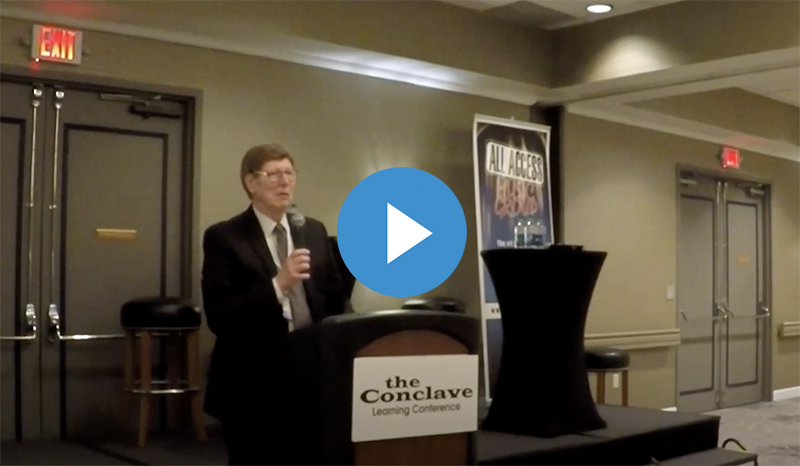
Often named among Radio Ink’s 40 Most Powerful People in Radio, Duke earned numerous accolades during his career. In 2016, the Conclave honored Duke with the Rockwell Lifetime Achievement Award for his contributions to radio and the community. You can watch his acceptance speech below.

Duke also served the greater broadcast community as a member of the Board of Directors for the Wisconsin Broadcasters Association. He was also inducted into the Wisconsin Broadcast Hall of Fame. On their website, you can watch a short documentary about Duke’s life and career.

As Midwest Communications carries Duke’s vision forward, Pegge Wright is now the Chairperson of the Board. There have only been two: Pegge and Duke. Last week, it was announced that Peter Tanz is now the President of Midwest Communications.

All of us are saddened by Duke's passing, but we remain grateful for the incredible impact he had on us and the radio industry as a whole. His spirit lives on in everyone at Midwest Communications and all of us at MusicMaster.

Multimedios Radio Joins MusicMaster on Client-Server Platform

We are proud to announce that Multimedios Radio has made the switch to MusicMaster Scheduling and has moved their programming operations onto our Client-Server (CS) platform.

Multimedios Radio is the radio division of the Multimedios group, which has several other media divisions including Television, Digital and Newspaper. Multimedios Radio operates more than 60 radio stations in different countries, with six in the United States, three in Costa Rica and 56 across Mexico. In Mexico, they cover the major primary markets such as Monterrey (base), Torreon, Tamaulipas, Guadalajara, Chihuahua, Nayarit, Baja California, Guanajuato and most recently, Culiacan and Merida. Besides these terrestrial markets, the company is also developing products to get into the digital market with new technologies, automation, artificial intelligence and IP technologies to leverage costs, high availability and quality. Some of Multimedios radio brands are pictured below.

According to Multimedios Chief Technology Officer Enrique Calderon Gaona, "Our mission is to be the preferred choice of information and entertainment for our audiences in terrestrial and digital, to expand our media into more markets, and deliver more quality products."

Enrique shared some thoughts on the decision to move to MusicMaster: "The process of switching to MusicMaster was thorough and precise. We elaborated a set of requirements and there were several platforms in the market that fit. We selected MusicMaster because of their Onboarding, Customer Service, collaboration and additional value that they were adding to the proposal. Technically speaking, MusicMaster is the leader among the market and very competitive."

Multimedios chose MusicMaster Client-Server for its ability to efficiently organize their programming operations across their entire network.

With CS, all data and processing are managed centrally. Users are able to access the system from a desktop client application or a soon to be released fully web based portal, hosted either on their own corporate servers or a fully cloud-based server suite as needed.

Organizations are able to better manage assets across a shared Enterprise library, with local data overrides as needed. Alongside the features of MusicMaster Pro, Client-Server adds many additional tools, such as multi-station scheduling, advanced security and user access control, automated tasks, streamlined log sharing across the network, and many more. Overall, the result is an improved IT infrastructure, asset management, and a reduction in redundancies, workloads, and management costs.

As CTO Enrique Calderon Gaona commented, "The technology is helping us to construct and develop a new strategy for our product. To organize it, add new business rules, and deliver a more efficient and competitive product to our audiences using MusicMaster's features as a competitive advantage. The collaboration and assessment from the team at MusicMaster has helped us to deliver that high end product and value to our customers."

Among the team leading Multimedios through this transition are MusicMaster Director of Operations Jerry Parker and Senior Music Scheduling Consultant Jesus Rodriguez. As Jerry commented, "I'm pleased to see our partners at Multimedios leveraging the Enterprise systems in CS to get better control of their assets, easily add new stations to the platform, and generate quality products on air! While I've been working with Enrique Calderon Gaona, Veronica Maquivar, and their management and IT teams on infrastructure and related systems, Jesus and his team of support consultants here at MusicMaster are working diligently on training their users, exposing them to new time saving workflows, and normalizing their databases into a more cohesive and easier to work with format. Congratulations to Enrique, Veronica, Liliana Marroquin, and the rest of the Multimedios team for being so good at what they do and making their transition to CS work so well."

Radiodays Europe in Prague - March 26 - 28

After its very successful revival after the pandemic in Malmö last year, the Radiodays Europe are now getting ready to welcome radio professionals from all over the world in one of the liveliest cities in Europe this springtime, Prague. Be prepared for three bustling days of meeting, learning, inspiring and being inspired, exchanging experiences and innovations - all set in a town bursting with high spirits, history, culture, music, parties and...pivo.

Are you planning to travel to Prague for the Radiodays this year? The team of MusicMaster's international distributor ON AIR would like to invite you to a very special Apero with a view. If you would like to join us in the early evening of Monday, March 27, drop a note: radiodays@onair.de

Upcoming Events
It's All About ME!

by Dave Tyler
I got my first radio job in 1983 at 1560AM WKIQ in tiny Inverness, Florida. The radio station was in a trailer between my house and the bus stop, so every day I would knock on the locked door and ask for a job. The PD was a guy named Greg and every day he said “No!”….well, until one day he opened the door and said “I’ll make deal with you, I’ll hire you but you can only come here when you are scheduled!”

He had me on the air doing Radio trader and running programs off of cassettes and records. I would say things like “It’s partly cloudy outside and I hope everybody has a nice day”. Greg would storm in and say “Has is it ever been partly cloudy INSIDE??? Ever??” and “Stop saying EVERYBODY….you are not talking to everybody, you are talking to individuals, you are talking to ME. If I hear you say EVERYBODY again, you’ll work every holiday for the rest of the year”. Fact was, I was 16 and the newbie and was already working every holiday and weekend, but his point was well received. We are not programming to the population but to each person in it.

For those that have seen me, it is clear that I love McDonald’s and Pizza Hut. A bag of burgers or a pan pizza and I’m a pretty happy dude. But if you ever visit me in Ocala, Florida and want a great burger, I will take you to the locally owned Lodge. Huge burgers, and the one with pork belly on it is ridiculously good. I mean you’ll take selfies with it, it is so good! And for pizza, we’re going to Lorito’s on the Blvd. It’s been there for 40+ years and has the finest pizza, and they make their own salad dressing too. You’ll be dipping your crust in it and savoring it like the last bite of lobster at a fancy dinner.

These are two of more than a thousand places, people, and things in my town that make it special, and your radio station is one of those important ingredients that makes your market so unique as well.

Ok so what does this have to do with MusicMaster? Gosh so much! Just as Stevie Ray Vaughan used a Fender Stratocaster to get the sound in his head out through his amplifier, MusicMaster is the tool you use to get that special, one-of-a-kind sound in your head out of the speakers. It is the reason why you can have two stations in the same market playing the exact same songs with equal talent and imaging, yet one is heads and shoulders above the rest to the listener.

Probably 60% of my career has been on the air, scheduling and programming Country music, so I am going to lean on that throughout this article. If I travel to Texas, I expect a huge helping of Aaron Watson, Pat Green, Lyle Lovett, Red Dirt, and Swing all spicing up the Country station I am listening to, and I would be disappointed if I didn’t hear it. Same goes if I am in Kentucky. I would be sad if I didn’t hear a lot more Ricky Skaggs and Alison Krauss. And you better believe if I am anywhere in Southern California near Bakersfield, I want to be overserved Buck Owens and Dwight Yoakam on the Country radio there, not to mention local artists. It’s part of the reason I love travelling. There is something special and unique about every market and it is important to program to the people who live there and give them that spice they love, even if the rest of the world doesn’t get it. Don’t schedule to EVERYBODY schedule to ME!

MusicMaster has so many incredible tools, like song coding for specialty programming and themed weekends (see my article on this here). This gives you the ability to present your sales team with focused programming they can sell to a targeted local clientele. In doing this, you’ll find sales team members coming up to you asking if you can have a themed weekend for the furniture store (hmmm ok rocking chair and porch sitting songs…I can do that!) to Beach/Lake/Boat themed weekends they can sell to the local Marine dealer. Local themes sold to local stores for the entertainment of the local individuals.

And it doesn’t even have to be a themed weekend. It could be something as simple as a ”Double-Shot Weekend” using MusicMaster Special Sets. Check out Paul Ziino’s great 4 part blog about Special Sets here: (Part One, Part Two, Part Three, Part Four). There is a station in my town that does this every Sunday and I listen to them exclusively because they pull it off perfectly and I love hearing two songs in a row by the same artist. They sell it and it sounds fresh and exciting and is literally playing on every radio in town and yeah…they use MusicMaster to do it.

You might have a hot Country station (or whatever format) that really leans on the new stuff but every time you are out at a remote or answer the phone, you keep hearing how folks miss hearing that 70s, 80’s and 90s Country. This could be an opportunity to highlight this music and to get it sponsored. Stick it in a “Oh Wow” or “Variety” category in MM or code it as such, and then you can highlight it as a once-a-show feature or a weekly program, or whatever way fits best.

We all know we can’t change the way we program willy nilly because one person said something, but if the market agrees that they love what you do already but sure wouldn’t mind hearing some other part of your format, then it is worth at least considering how to fill that need if you find there is a legitimate hole in the market. Give the people what they want.

Consultant Keith Hill said to me many, many years ago “Every time you crack the mic you need to prove you live here”. That is a huge statement and goal, and it is not always easy, but it is right. Our listeners each have a plethora of ways to get their music. Heck, I’m a radio guy and I have a couple dozen Amazon and Spotify playlists myself! However, if an individual feels you are speaking to them, relating to them, feeding them music they want to hear by introducing them to great new music and local talent, and surprising them with great old tunes, they’ll be intrigued and stick around to hear more.

Coding your music, Special Sets, using migrating positions…MusicMaster has so many tools for you to use to make your sound pop and keep sounding fresh. The thing that gets me out of bed each day is the fact that I know I will get a call from a Programmer that has a cool idea and really wants to make it come out of the speakers! To me, that is the fun stuff and I know I speak for my colleagues here at MusicMaster when I say those are the calls they get the most excited about too. We are here and ready for the next great idea that will make your station like that great burger folks keep coming back for day after day! Yum!

How To Install The Latest Version of MusicMaster

by Chris Hulsether
Maybe you want to do an update or even install the software for the first time, but you’re not sure how to proceed. This article will give you step-by-step instructions on how to properly update or install your MusicMaster Software.

If you are installing the software for the first time, you can go to the MusicMaster website to check the basic recommendations for the hardware specs we suggest.

1. Purge and Backup Your Existing Database

First, if you already have MusicMaster installed and are looking to update, we recommend doing a Purge and then saving a safety Backup in a special location outside of your local system (Flash Drive, Network location, External hard drive etc..)

This is important because once you upgrade to a new major version (like from Version 7 to Version 8) and open your database in that new version, it no longer be compatible with any previous versions. Note that this does not apply to service releases. You can open your MusicMaster database in either a newer or older service release, as long as the major version number is the same.

If, after updating, you needed to back to your old database for any reason, you’d need access to a copy of the database that hasn’t been opened in the newer version yet. Keeping this safety backup in an external location ensures you won’t get the old and new databases mixed up.

Before purging or backing up your database, we recommend you open Tools > User List to confirm you are the only one in the database.

Once it’s confirmed you are the only one in the database, Run Tools > Purge, before making your database backup. This utility removes extra space from your data that could cause your backup to be larger than it needs to be. This will also have the benefit of speeding up your database.

It may be a good idea to verify the location of your database(s) and backup(s) with your IT support staff.

2. Do a Back Up!

When Purge is complete, you can now backup your data (Tools > Backup). Look for any .def files or special .ini files we’ve created for your specific databases. You’ll also want to make copies of these files and save them in a location that is not on your local drive. Copy the zip file (typically something in the format Call letters.ZIP), from your Data folder and paste it in that location. If you have any questions about specific files that you think may need to be carried over to the new machine, please contact your Music Scheduling Consultant.

3. Download the Latest Version of MusicMaster

Whether installing for the first time or updating, you can download the latest version of the application from the support site musicmaster.com. Once you’ve logged on to our web site (LOGIN), complete the station information section of your online registration, then go to Downloads and select the version of MusicMaster you want to upgrade to.

4. Install the Software

Before installing, we recommend creating a MusicMaster folder in your C Drive (C:\). Then, during the Install process, you can change the default folder from C:\Program Files (x86) to this C:\MusicMaster folder you’ve created. If you already have a separate folder like C:\MMWin or C:\MM80, you can use that folder to install the software.

We recommend whatever your current folder is called, that it is not in the Program Files (X86) or Program Files folder in the C Drive of your computer. We recommend that the folder you currently have or are creating for the first time is in the C Drive by itself. During the Install process, all of your older versions of MusicMaster files will be uninstalled and new files will be placed in this folder, so you do not need a separate folder for the older version of MusicMaster.

Once you’ve downloaded the full installer of the application (make certain you have Admin rights before you begin), go ahead and run the installer, and follow all of the prompts. In most cases, you will not need to make any changes to the default settings the installer will suggest, except for the Data folder location. This is where your MusicMaster database files will be stored. Just make sure it is not in the Program files (X86) folder. Then you can restart your computer to complete the install/update.

5. Installing the License

Now about those green dongles… How would you like to add a keyless license at no extra cost, where you never need a dongle and you can add as many computers as you need?

If you are a brand new user, you will automatically receive a keyless license. Instructions will be emailed to you separately. We can add as many seats as you need to this license, which means you can use that code on that number of computers. If you need additional seats, let us know.

If you already have a green dongle, you can upgrade to keyless. Ask your Music Scheduling Consultant about this and they can get a license to you right away and you can add it instantly. You need to be on version 7.0.13 or higher, which includes all version 8 databases. Then you can mail back your dongles to us. The same goes for red network keys. This can be very helpful if you are looking to add a Nexus Server with your automation system (see list of automation systems compatible with Nexus here)

If you have any questions or need assistance, please contact your Music Scheduling Consultant to help you make this update happen!

  Quick Tip

Database Field Categories

One of the best things about MusicMaster is its flexibility. For example, not only can you add as many custom fields to your database as you wish, but you can also choose which fields to display in your library or schedule editor at any given time. You can even save multiple different layouts for different users or tasks.

If you're someone who has created a lot of different fields in MusicMaster, you may have a long list of fields to pick from when using the Grid Layout Editor. Of course, you can always sort the list A to Z. But did you also know you can group different fields into category folders? For example, you can put all fields relating to Research, Chart Data, Coding, Keywords, and so on, all in their own folders. This helps keep them organized, especially if you don't remember exactly what you named a field, but know in what category you might find it.

To do this, first go to your Dataset > Library > Fields menu to open the Field Editor. In the Category column, type in whatever label you want the category to be. Fields with the same label will be grouped together.


Then, in your Grid Layout editor, you can toggle to the Category view (the button left of A-Z). Now you can see all your category labels, and can click to expand each list. Any field that isn't in a category will be listed in alphabetical order below.

Welcome to MusicMaster!

Use the dropdown menu below to view a list of stations and locations.
Click a station on the list to visit its homepage and listen live!


Mike Wilson

On-Air Music Director - Salem Media Group KKFS/Sacramento

Mike 'Allen' Wilson got his start working at KNTY/Sacramento in promotions back in 2007, which was perfect thanks to his love of country music. During his 10-year tenure at KNTY/Sacramento he moved from promotions assistant to APD/MD/On-air personality and was running the day-to-day operations at the station. Also, during that time he was on air doing weekends/fill-ins at EMF Broadcasting (Air 1/K-Love). In 2017, Mike left KNTY/Sacramento to work full-time on air at EMF Broadcasting to do the afternoon show on their Air 1 Radio Network. In 2020, he started working for Salem Media Group KKFS/Sacramento as the on-air music director, where he still works today.

Over the last 15 years working in radio, technology has come a long way. While I was not around for the 'good ol days' of radio with reel to reels, vinyl records and 3x5 cards to pick music, even in my short time I have seen how these changes have made programmers' lives easier. I started my programming career using Selector 15. Not a bad product, at least it was windows based instead of the DOS version they were using at corporate, and since it was my first experience it was 'cool'. The thing about your first, you don't know what you're missing, now that I've moved on to Music Master, I don't think I could ever go back. There are just so many things about Music Master I love.

Mike shared some of his favorite and most useful MusicMaster features: "I think the most valuable asset has been the support to figure out how to make the program do what I want it to do. With the previous versions of Selector I had experience with, trying to create variety on the playlist was difficult. In MusicMaster, there are at least three different ways to create variety in your clock without affecting rotations (I've found Proportional Elements to be the most effective). Previously, I had a rule tree, but the options were 'unbreakable' and 'breakable'. The Optimum Goals in MusicMaster have helped my library, especially golds, be more consistent. Now I don't have dozens songs that never get airplay because of artist separation. The way MusicMaster weighs those songs help keep everything rotating.

"Also, when trying figure out rotation calculations during Christmas, I love the Turnover Analysis tool. No longer do I have to make changes, schedule a test, and see if my math was correct. Now I can make changes, add a song or slot, and see how it will affect the rotation on a macro level. Not to mention, with how MusicMaster seamlessly works with Wide Orbit, now our live talent can fill songs using my MusicMaster rules instead of whatever whim they are feeling. It's awesome.

"MusicMaster truly is a great product, I know there are other options out there and I'm sure they are capable programs, but I would put up my MusicMaster library and scheduling to any of them in a heartbeat. Moving from Selector 15 to Music Master was scary at first but now I love it."

MusicMaster, Inc.
MusicMaster.com

8700 Stonebrook Pkwy, #1167
Frisco, TX 75034
sales@musicmaster.com
469.717.0100