
MusicMaster Blog
Autoburn posted on January 30th, 2026
by Brian Wheeler
It’s time to talk Autoburn. What is it? Why would I use it?
First, let’s talk a little bit about scheduling theory. When programming a music-heavy radio station, our goal as broadcasters is to entertain our audience. We want to provide a product that pleases and entertains the listeners. Obviously, you’d do well to ensure that they’re listening to good music. The audience also likes to hear some variety in that music. That doesn’t necessarily mean you need a huge library of music. Rather, it’s equally important that you rotate your existing library in such a way that the music hits different dayparts and different hours regularly. The hope is that our audience, which is generally comprised of ‘creatures of habit,’ is exposed to a varied portion of your library at any given listening session. In that case, the perception by those listening is that you have a comprehensive, yet focused library you’re presenting to them whenever they tune in.
So how do we get more varied rotations? I get asked a lot about the ‘magic numbers’ needed to attain perfect rotations. While there are some numbers that sometimes work better than others, it really comes down to math. Not all numbers are equal in that respect. I CAN tell you that numbers I tend to avoid also evenly divide into 12 and 24, since we’re generally working with a 24-hour day. Here’s a brief illustration of that math.
A category that has 6 songs in it and is called for once an hour in your clocks will rotate like this: 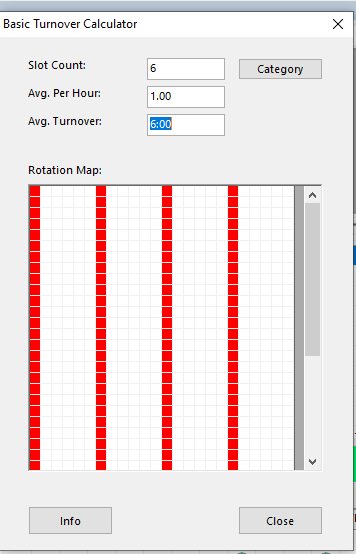
The same song plays at midnight, 6am, noon, and 6pm every day. Your ‘creatures of habit’ listeners are now living in Groundhog Day and they are hearing “I Got You Babe” every morning courtesy of your radio station. That’s no good. A 12-song category would hit at midnight/12p, etc. etc. This is bad math, rotationally speaking.
The easy answer is, fix your math. Instead of 6 songs played once an hour, play 5 or 7 songs, right? Typically, this is the way.
But what if you can’t fix the math? What if you are mandated to play 6 songs? Or let’s say you’ve done an auditorium test and you’ve now got 144 great-testing gold songs you want to play, but you use 3 an hour and that combination makes your rotation look like this?
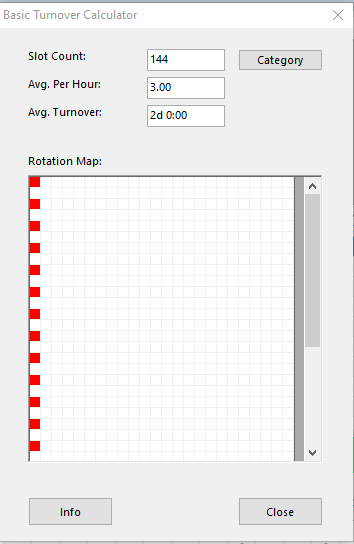
Here’s where Autoburn can shine. Autoburn is designed to throw a proverbial monkey wrench in the works. How does it work? You decide where you’d like to ‘burn’ one or more songs to offset the poor rotation brought on by category size and clock calls.
For example, you’ve got a 7-song current category that would rotate well, but you simply don’t play that category in your morning show. What should be a great rotation is fouled by the absence of your Power Category for three hours a day. Look at that stacking below! Hideous.
Turnover Analysis (shown in our Web Client) showing bad turnover:
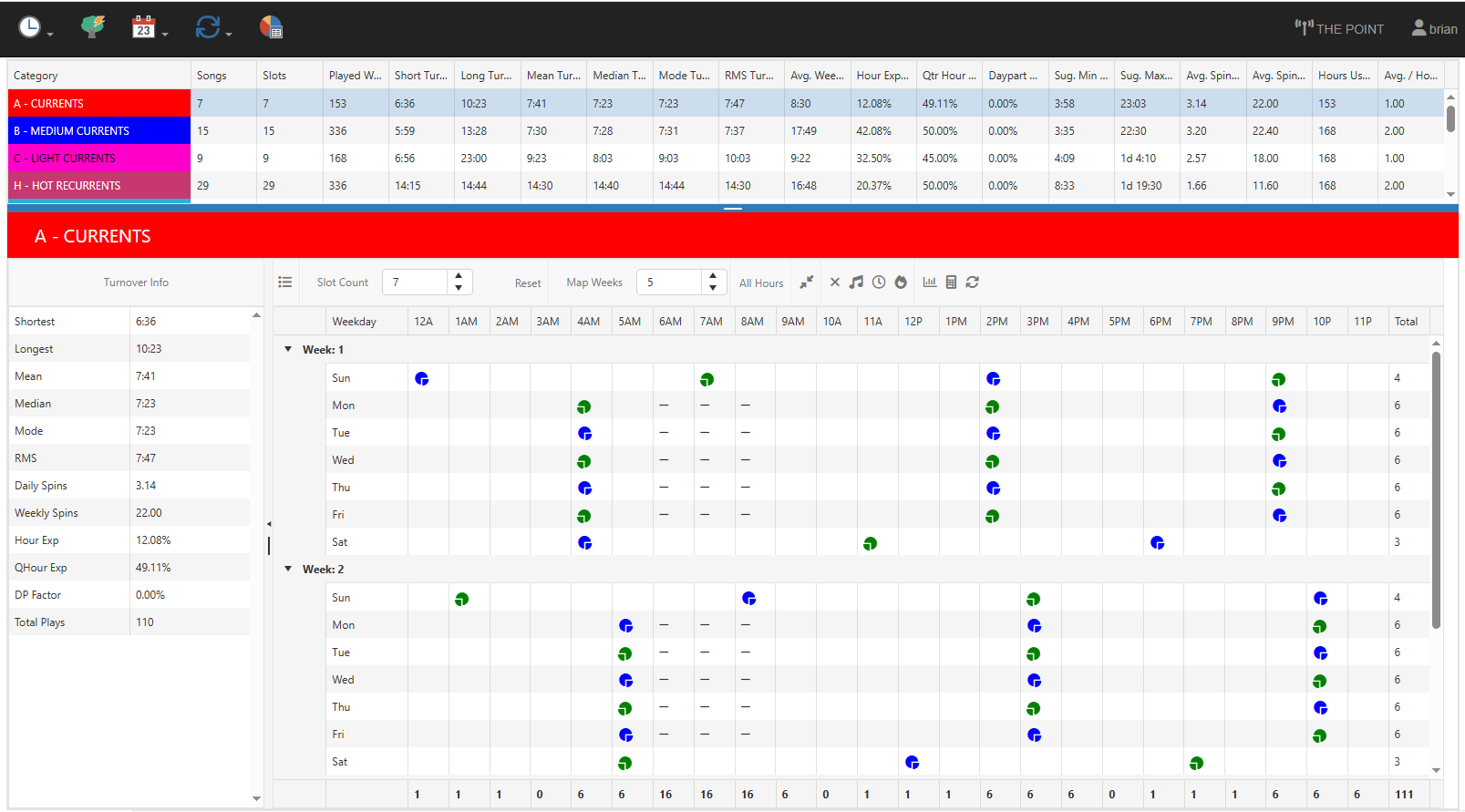 But, if we simulate plays during those 3 hours a day, we can right the wrong.
Let’s add an Autoburn of one song to the three hours of the morning show. The Autoburn skips the next current to play in each of those hours to perpetuate the good stair-stepping pattern that our good math would have provided had we actually played the song.
Shown in CS:
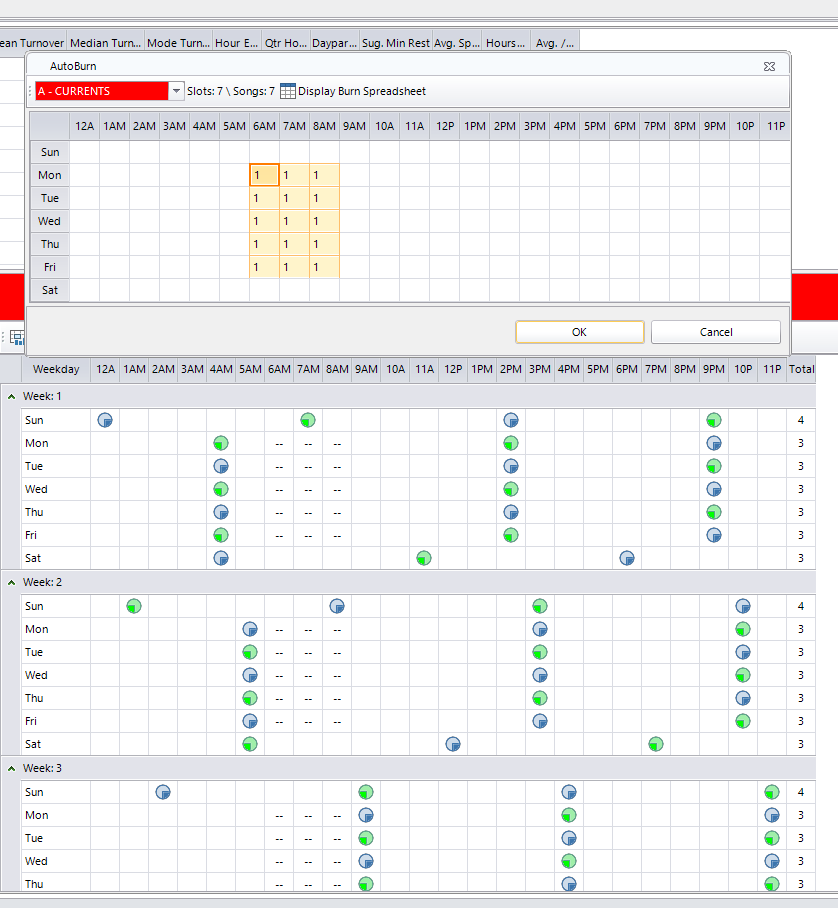
Click OK, and MusicMaster will recalculate the rotations now that there is an Autoburn setting to offset the three missed plays in the morning show. Here is the result of our Autoburn setting.
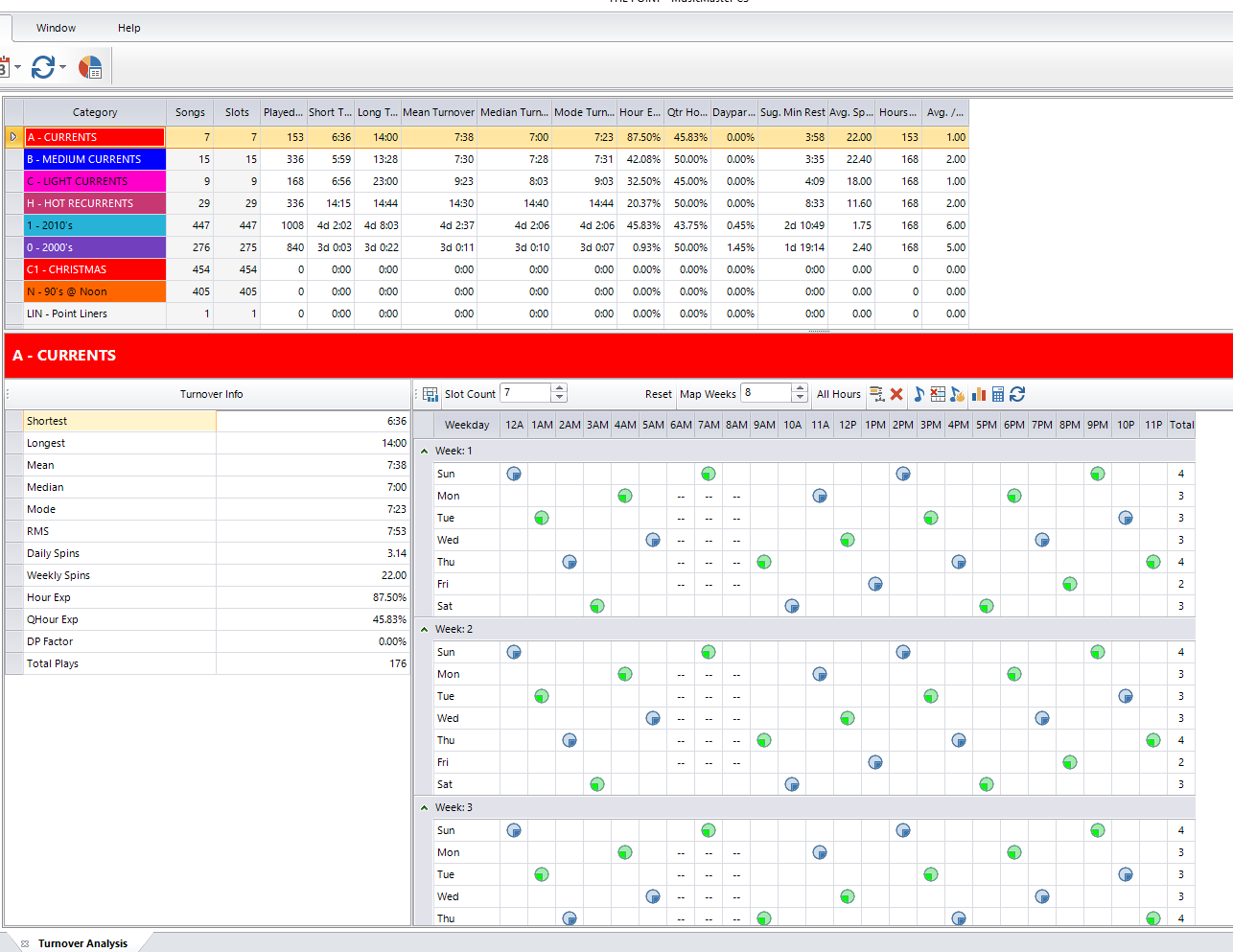
Ah, yes… that lovely stair-step rotation almost brings a tear to the eye. All is well again.
When your rotations aren’t quite right, the first thing I’d recommend is checking your math. Using the Turnover Calculator is a very handy tool for doing a lot of math for you. Make sure your category size, clock calls, and any other factors and influences such as Dayparting and Gold Recycling are as intended. If you’re certain that everything checks out and you still require a rotation adjustment, Autoburn may be the tool that makes the difference.
As always, feel free to reach out to your MusicMaster MSC for more information or assistance in applying this tool if you’d like some help.
When to Use Autoburn posted on June 8th, 2020
by Paul Ziino
Last week Marianne Burkett went over some of the things to consider when scheduling and looking at your rotations. Today, I’ll take a deeper dive into how you can use AutoBurn to assist with your rotations.
Imagine having perfect rotations all the time. Five songs in a category that is called for once per hour every hour of the broadcast week. You’d expect a nice rotation that looks like this.

But what happens if some hours don’t call for that category?
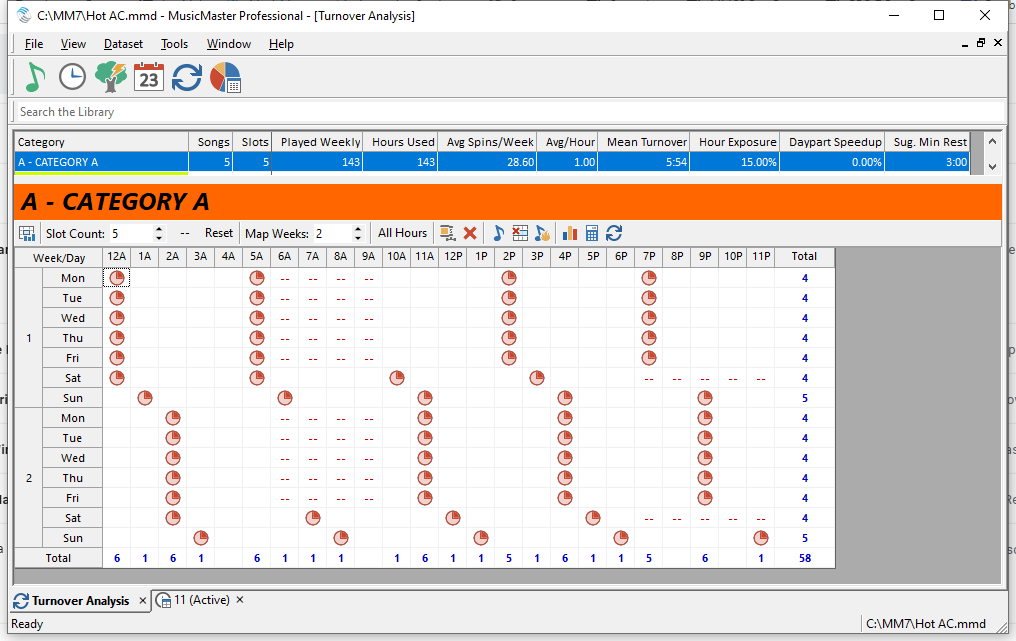
What can you do to fix this? The answer is Auto-Burn. In the Turnover Analysis grid, click the music note with the flame next to it.
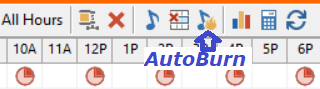
This will open up the Auto-Burn editor which is a grid representing the 168 hours of the week. In each of those squares you can enter the number of songs you’d like to automatically burn when that hour is scheduled.
When the math works like five songs in a category playing one per hour, you can start by burning the number of missing plays in those hours where the category is not called for. This will help balance out the rotation. In our example we aren’t playing this A category in weekday morning drive nor on Saturday evenings. So we’ll burn one song in each of those hours.

When we click OK the AutoBurn screen will close and the Turnover Analysis will refresh showing you the new result of your AutoBurn adjustment.
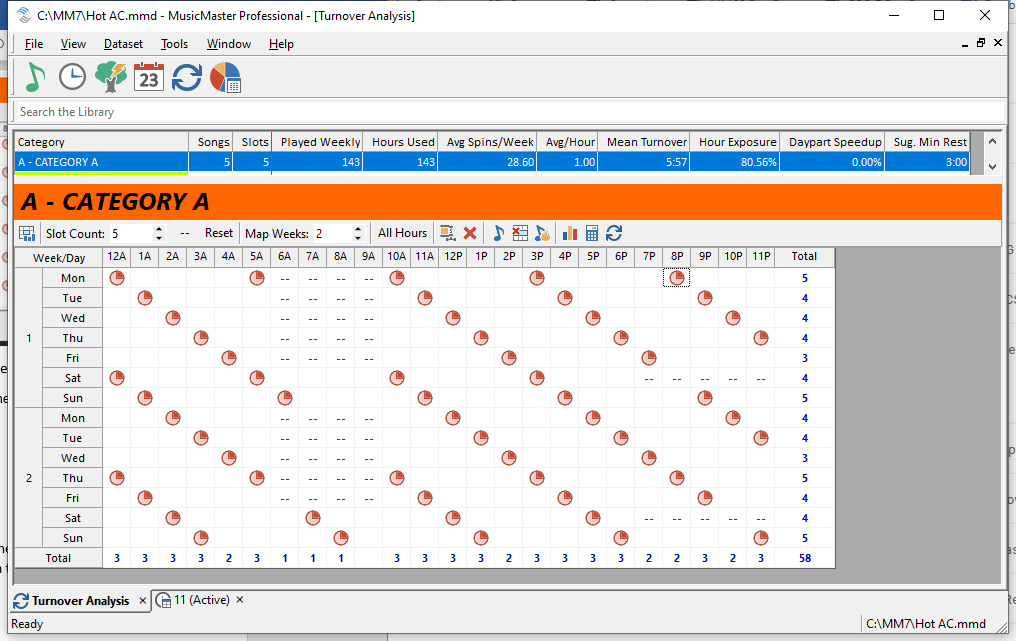
We can still see there are hours where A is not called for, represented by the dashes in the grid. And we can see that despite the category not being used in those dashed hours, the rotation pattern is consistent.
Let’s take another stab at this. Same category of five songs. But some hours play two and others play one and a few have zero A category songs. We can see what hours contain plays of the category by clicking the music note for Format Clock Category Usage.

And it looks like this.
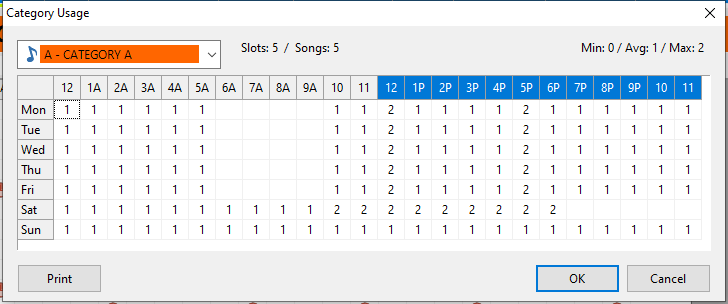
With no AutoBurn set up, we have a natural rotation that looks like this.
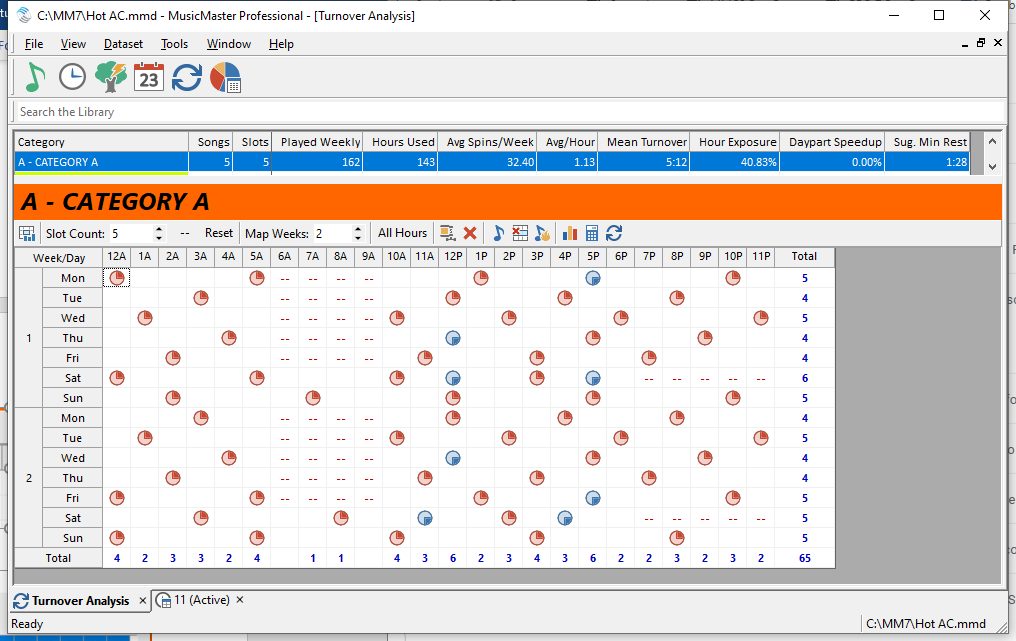
How do we fix this? This is where the AutoBurn Spreadsheet comes in handy. Click the AutoBurn icon, then check the box to “Display Burn Spreadsheet.” Note, the Burn Spreadsheet only works in categories with fewer than 26 songs, where AutoKick is not used, and Dayparting rules are not implemented.
When we look at this spreadsheet we are seeing where all the songs in the category are expected to plot based on the clock calls and number of songs in the category. In the upper left corner above 12A and to the left of the first day of the week is the letter A. Click here and it becomes a pulldown representing each song in the category. ABCDE for five songs in the category.
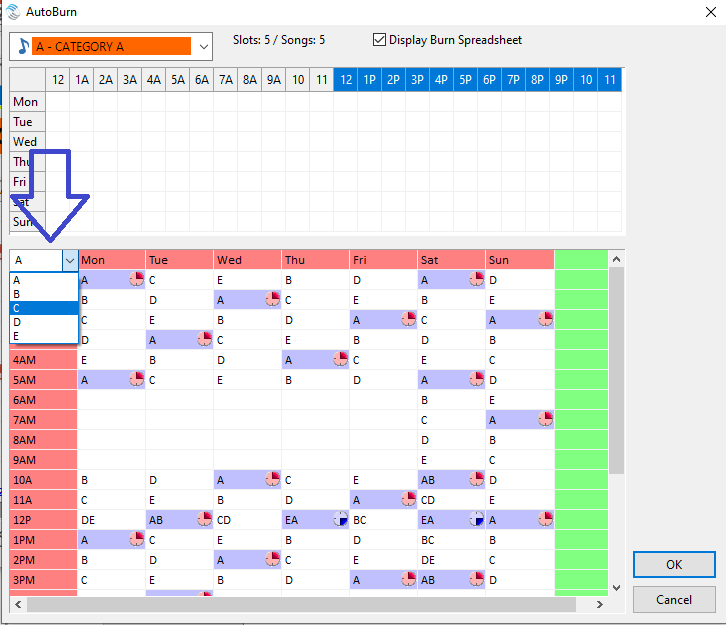
When you switch letters in that pulldown you will highlight the chosen letter in the grid. It defaults to the first song, A, in the category. In a perfect world we want to make sure we don’t repeat a song in the same hour during the week until all the others have plotted. Looking at the Midnight hour in the above graphic we see Mon plays the A, Tue is C, Wed is E, Thu is B, Fri is D, then A is repeated on Sat. So we’ve covered the entire list of songs in the Midnight hour. That’s great. We can also see at a quick glance that during the overnight hours A never plays in the same hour two days in a row. Nor does B, C, D, or E. Perfect overnight rotations.
Let’s scroll down later in the day and we’ll see Mon-Fri we have no song playing in the same hour in back to back days. That’s excellent!
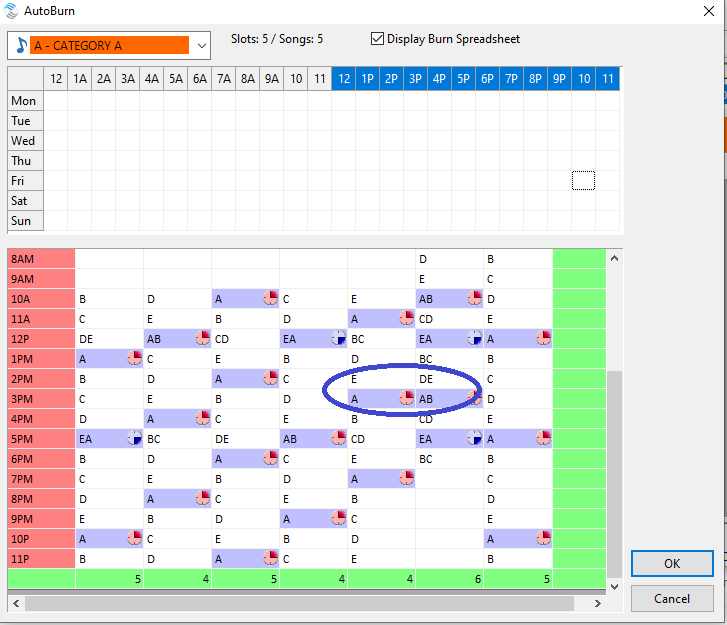
But what we do see are songs stacking up between Fri/Sat, and between Sat/Sun. We’ll need to fix this. Let’s start by looking Friday to Saturday. We see in the 2pm hour the E stacks, and A stacks in the 3pm hour. That means we’ll want to AutoBurn in those hours to fix this rotation problem. Let’s burn two songs in the Sat 2pm hour to move the D and E out of that hour.
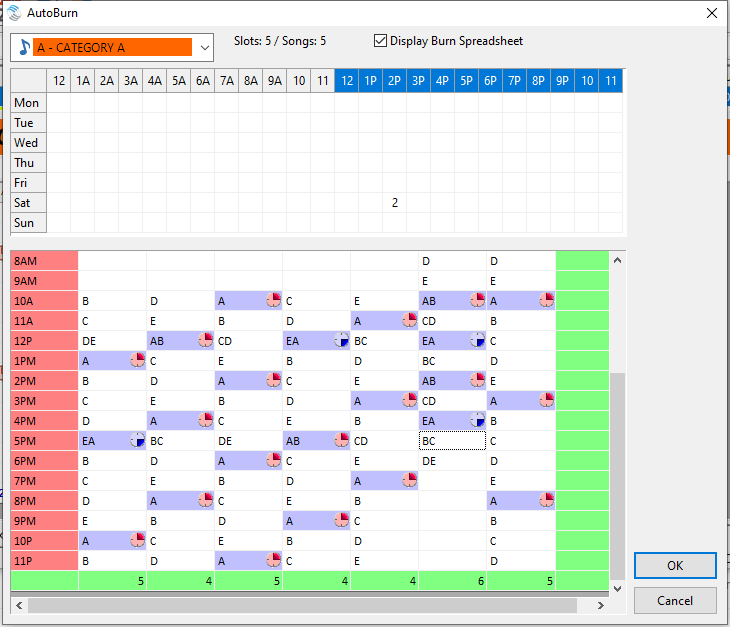
Now 2p and 3pm are ok, but we see the C playing in 5pm on Fri and Sat, and the E at 6pm both days. We’ll need to burn three more at 5pm on Sat to fix this.

So now we’ve fixed the problem of stacking between Friday and Saturday. But we have a new problem! Songs E and A are playing in back to back hours now at 4p and 5p on Saturday. What can we do to fix that problem? We’ll have to stagger our 3 burns so they don’t all happen at the same time. If instead we burn one song at 3p and two at 4p we get the desired result. No stacking between Fri and Sat, and no songs playing in back to back hours.
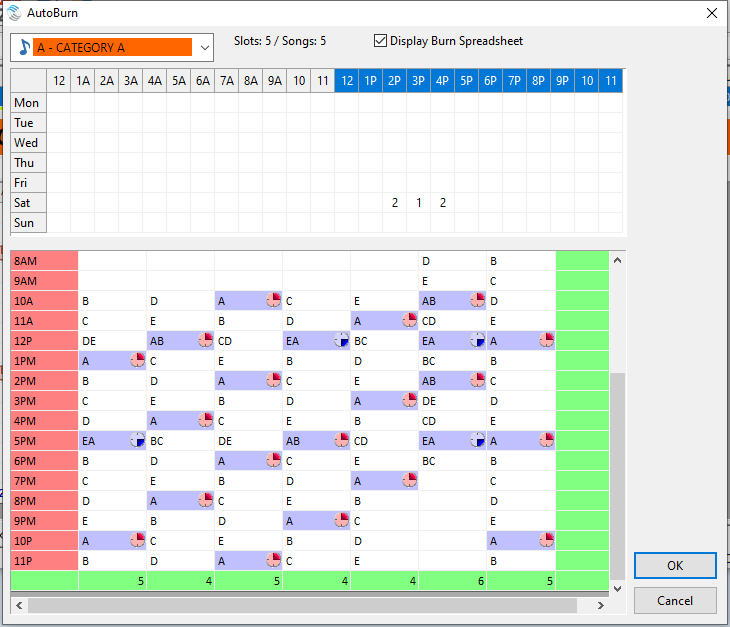
Now we have to clean up the stacking between Sat and Sun. Everything is looking okay until we get to Noon on Sun where we have song A stacking up, then B stacks in 1p, D in 3p, A again in 5p and B in 6p. AutoBurn to the rescue!
We’ll need to burn two songs at Noon on Sun to prevent stacking between Sat and Sun.
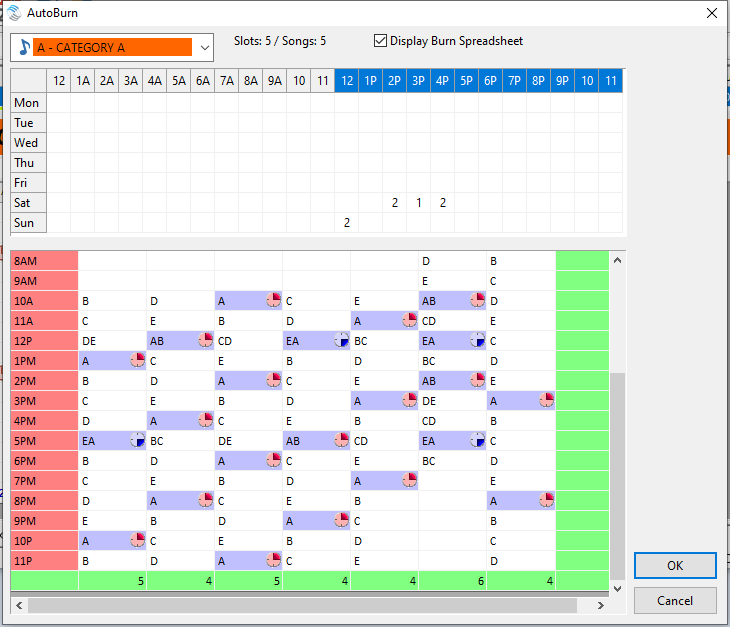
Click OK and MusicMaster will save those changes made to the AutoBurn spreadsheet and update your Turnover Analysis display.
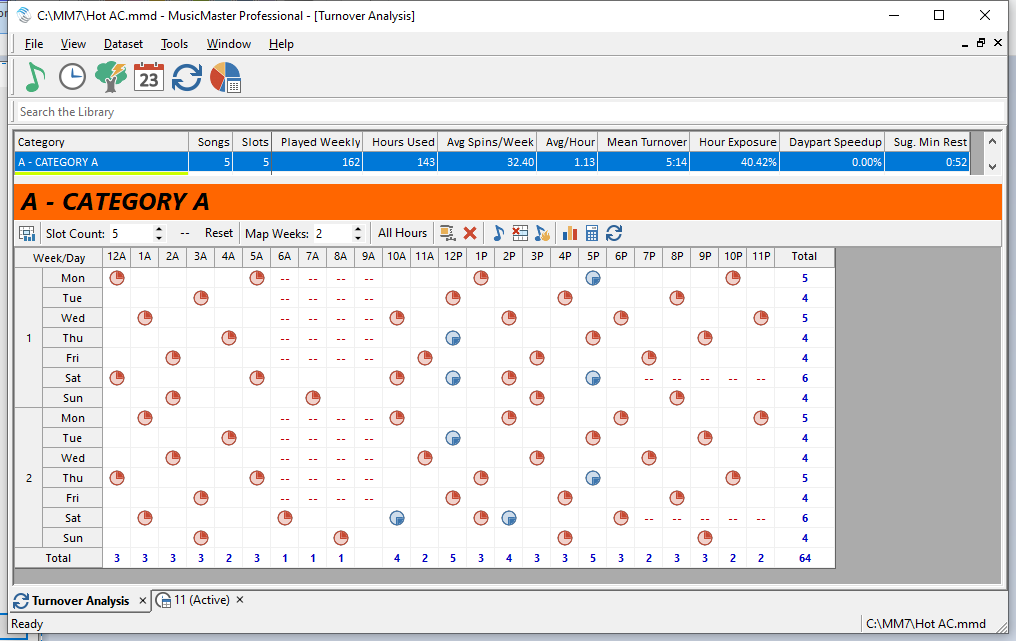
Look at the bottom row of totals. Over two weeks the song is spread out pretty well all things considered. It doesn’t get many spins in the morning drive show since it’s only eligible to play there on weekends. We play two per hour during the week at Noon so the count is a little higher there. If we look at the total column on the right things are well balanced there.
AutoBurn can’t fix everything, but it can fix a lot of things. Just keep in mind when using AutoBurn that if your clocks change or your category count changes, your AutoBurns will likely need to change as well.
Need help with your rotations? Maybe you want to see if AutoBurn can help? Call your MusicMaster Scheduling Consultant. We’re happy to assist!